














Crystal Travel | Travel News | April 2026
Fuel supply falling dangerously behind EU mandates — and your summer 2026 flight could be next.
Scandinavian Airlines (SAS) has issued a serious warning this week, alerting the aviation industry that a deepening shortage of sustainable jet fuel could trigger airline route cuts across key European markets — including the UK, Germany, Spain, and Italy. For millions of British holidaymakers with summer flights already in mind, the warning could not have come at a worse time.
In a report released in late April 2026, SAS warned that Europe is on course for a structural shortage of electro-sustainable aviation fuel — known as e-SAF — precisely at the moment EU law begins demanding its use. Without a rapid build-out of production capacity, the airline said the consequences would be felt directly by passengers through higher fares, fewer routes, and a weakened aviation network across the continent.
Mads Brandstrup Nielsen, SAS's Senior Vice President for Sustainability, was unequivocal. "What we are seeing now is a reminder of how exposed Europe remains to global fuel shocks," he said. "If we fail to build domestic e-SAF production, we risk creating a second vulnerability — this time inside a regulated system where demand is mandated but supply is not."
The EU's ReFuelEU Aviation regulation legally requires airlines and fuel suppliers at European airports to blend increasing proportions of sustainable aviation fuel into conventional jet fuel, with firm e-SAF targets coming into force from 2030. The problem is stark. Not a single e-SAF production facility in Europe has been formally committed to construction. The regulation is in place, the demand is coming, but the supply infrastructure simply does not exist yet.
The UK faces its own version of this pressure. Alongside EU rules governing European airports, the UK Government runs a parallel sustainable aviation fuel mandate covering British carriers and airports. Airlines operating out of Heathrow, Manchester, Birmingham, and Gatwick are navigating obligations on multiple fronts — and those costs filter directly through to the passenger at the point of booking.
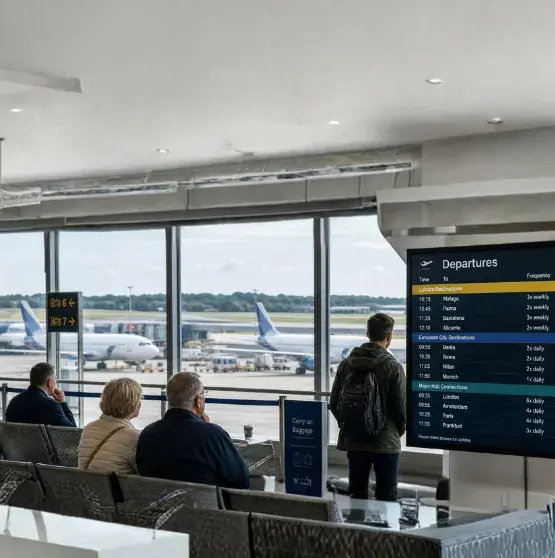
The pattern in aviation is well established. When operating costs climb, airlines raise fares first and then cut the routes that can no longer pay their way. Regional connections, off-peak frequencies, and thinner routes to secondary airports are always the first to go.
For UK travellers, flights from regional airports to destinations across Spain, Germany, and Italy face the greatest risk of reduction. Routes to popular holiday spots in these countries are more exposed than high-frequency services out of major London airports — though even those are not shielded from fare increases as the wider cost environment tightens across the industry.
The message from travel experts is clear — act now, not later. Fares on European routes departing UK airports are already moving upward, and that trend is unlikely to reverse before the summer peak. The longer bookings are delayed, the higher the price and the narrower the choice.
Before confirming any summer plans, UK holidaymakers should verify their chosen route is still being actively operated, ensure travel insurance covers flight cancellations and disruption, and, where possible, secure a flexible booking that offers protection if schedules change before departure.
At Crystal Travel, our team is tracking developments across European aviation closely. Whether you are flying from anywhere in the UK to Spain, Italy, Germany, or beyond this summer, we are here to help you plan and travel with confidence.
Verified by Our Travel Operations Expert



Got Questions? Call us 24/7!
02030237773
Email for Us!
support@crystaltravel.co.uk
12 Stephen Mews, London W1T 1AH, United Kingdom.

Copyright © 2026 Moresand Ltd.(Reg No.02114691) T/A CrystalTravel registered in England and Wales.
Many of the flights and flight-inclusive holidays on this website are financially protected by the ATOL scheme. But ATOL protection does not apply to all holiday and travel services listed on this website. Please ask us to confirm what protection may apply to your booking. If you do not receive an ATOL Certificate then the booking will not be ATOL protected. If you do receive an ATOL Certificate but all the parts of your trip are not listed on it, those parts will not be ATOL protected. If you have booked a flight only where the ticket is not issued immediately, your flight will be protected under our ATOL. Please see our booking conditions for information, or for more information about financial protection and the ATOL Certificate go to ATOL Certificate