
 22 Jul, 2026
EasyJet Summer 2026: 53 New Routes and 39M UK Seats
22 Jul, 2026
EasyJet Summer 2026: 53 New Routes and 39M UK Seats

Crystal Travel | Travel News | 20 April 2026
With the EU's new Entry/Exit System disrupting airports across Europe, Greece has temporarily stepped back from enforcement to keep holidays on track.
The introduction of the European Union's new Entry/Exit System in April 2026 has changed the border experience for millions of travellers heading into Europe. Longer queues, unfamiliar biometric procedures, and stretched airport operations have become a growing concern across the continent. Greece, however, has taken a notably different approach — temporarily suspending the enforcement of biometric registration at its border crossing points to ensure the arrival experience remains smooth, efficient, and welcoming ahead of the busy summer season.
In response to these challenges, Greece has confirmed a temporary suspension of biometric registration requirements at its borders. The decision, announced through the Greek Embassy and supported by the Greek National Tourism Organisation, is a clear and practical response to the pressures the new system places on high-volume tourist destinations.
Greece welcomes millions of international visitors each year, with its island airports in particular handling enormous passenger numbers during the summer peak. Introducing time-intensive biometric processing into that environment — while the system is still finding its feet across Europe — carried a very real risk of delays, missed flights, and widespread disruption. By temporarily stepping back from EES enforcement, Greece is prioritising the operational flow of its airports and the overall experience of its visitors.
Travellers arriving in Greece will continue to go through the familiar process of presenting their passport for a quick check and receiving a physical stamp. No official end date for the suspension has been announced, so travellers are encouraged to monitor guidance from official sources ahead of their trip.
The Entry/Exit System, widely referred to as EES, is the EU's new digital border management framework. Launched across Schengen member states in April 2026, it replaces the traditional passport stamp with a digital record that captures biometric data — including fingerprint scans and a facial photograph — from all non-EU travellers each time they enter or exit the Schengen zone.
The system was designed to modernise border security and improve the monitoring of travel durations across EU member states. However, the early rollout has exposed real operational challenges. Airports across Europe have reported significant congestion at border control points, with processing times rising sharply and some travellers experiencing delays of several hours — a serious concern for any major tourist destination heading into its busiest months.
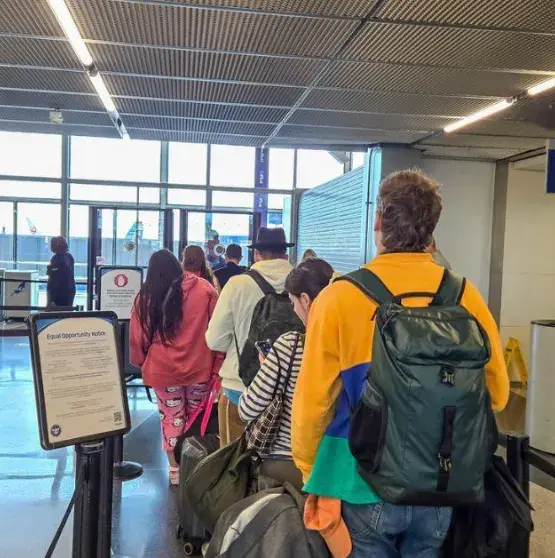
There are several important points to keep in mind. The suspension applies exclusively at Greek border points. Full EES biometric procedures — including fingerprint scans and facial photographs — remain in place across all other Schengen countries. Travellers visiting multiple European destinations on a single trip should allow additional time at border control in countries outside Greece.
The standard Schengen rules continue to apply in full, including the 90-day-in-180-day stay limit for non-EU visitors. Passport validity requirements remain unchanged. As this remains a temporary measure with no confirmed end date, staying up to date with the latest official travel guidance is strongly advisable.
It is also worth noting that the EU's ETIAS travel authorisation scheme is expected to launch later in 2026, introducing a further pre-travel step for non-EU travellers heading to Europe.
For anyone with a Greek holiday on the horizon this summer, this is genuinely positive news. From the historic streets of Athens to the sun-soaked shores of Crete, Santorini, and Rhodes, travellers can look forward to a faster, more straightforward arrival experience.
Get in touch with Crystal Travel today and let our team help you plan the perfect getaway.
Verified by Our Travel Operations Expert
 22 Jul, 2026
EasyJet Summer 2026: 53 New Routes and 39M UK Seats
22 Jul, 2026
EasyJet Summer 2026: 53 New Routes and 39M UK Seats
 22 Jul, 2026
Fuji Dream Airlines E175 Order Announced at Farnborough
22 Jul, 2026
Fuji Dream Airlines E175 Order Announced at Farnborough
 22 Jul, 2026
Qatar Airways Extends Double-Daily A380 Flights to Heathrow
22 Jul, 2026
Qatar Airways Extends Double-Daily A380 Flights to Heathrow
 22 Jul, 2026
Ryanair Stansted to Tirana Flight Diverted to Luxembourg
22 Jul, 2026
Ryanair Stansted to Tirana Flight Diverted to Luxembourg
 22 Jul, 2026
British Airways Selects GTF Engines for New Airbus A320neo Fleet
22 Jul, 2026
British Airways Selects GTF Engines for New Airbus A320neo Fleet


Got Questions? Call us 24/7!
02030237773
Email for Us!
support@crystaltravel.co.uk
12 Stephen Mews, London W1T 1AH, United Kingdom.

Copyright © 2026 Moresand Ltd.(Reg No.02114691) T/A CrystalTravel registered in England and Wales.
Many of the flights and flight-inclusive holidays on this website are financially protected by the ATOL scheme. But ATOL protection does not apply to all holiday and travel services listed on this website. Please ask us to confirm what protection may apply to your booking. If you do not receive an ATOL Certificate then the booking will not be ATOL protected. If you do receive an ATOL Certificate but all the parts of your trip are not listed on it, those parts will not be ATOL protected. If you have booked a flight only where the ticket is not issued immediately, your flight will be protected under our ATOL. Please see our booking conditions for information, or for more information about financial protection and the ATOL Certificate go to ATOL Certificate