















Crystal Travel | Travel News | 6th May, 2026
Travelling to Europe with pets from the UK: latest EU pet travel rules, Animal Health Certificate fees, and Brexit updates
British pet owners are being warned to check their travel paperwork carefully before booking a European holiday with their animals, following a rule change that has caught thousands of travellers off guard. Dogs, cats, and ferrets that were once able to cross into EU countries with minimal fuss are now subject to a stricter documentation process, and the costs are adding up fast.
Following Brexit, UK-issued pet passports stopped being recognised for travel into the EU. Many British owners found a practical workaround by obtaining EU-issued pet passports through vets in countries such as France, Spain or Belgium. These passports were valid for the lifetime of the animal and allowed owners to travel repeatedly without additional paperwork or fees each time they crossed the Channel.
That loophole has now been firmly closed. EU pet passports are only valid for owners whose main home is within the EU. British residents — regardless of how long they have held an EU-issued passport — can no longer rely on them when travelling to Europe with their pet.

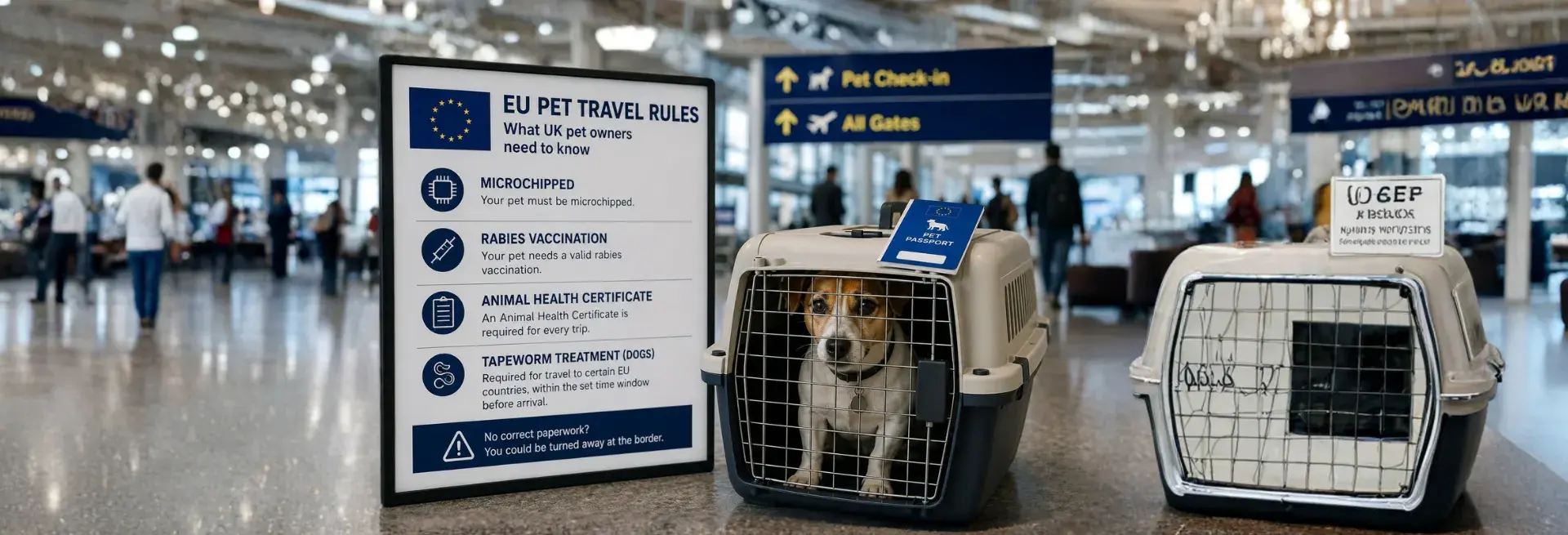
Any pet owner travelling from England, Scotland, or Wales to an EU country must now obtain an Animal Health Certificate before every single trip. The certificate must be issued by an authorised veterinarian no earlier than ten days before departure and is valid for one journey only — it cannot be reused for a future trip.
Before travelling, pets must be microchipped and have a valid rabies vaccination on record. Dog owners heading to certain EU countries, including Ireland, Malta, and Finland, will also need to arrange tapeworm treatment within a set window before arrival. Arriving at the border without the correct paperwork can result in being turned away entirely.
The cost of obtaining an Animal Health Certificate varies between veterinary practices, but it is an unavoidable expense for every trip to Europe. For owners who travel more than once a year, or those with more than one pet, the bills stack up considerably. Unlike the old passport system — a one-off lifetime cost per animal — the new process means returning to the vet and paying again before every journey abroad.
Several owners have reported discovering the change only days before a planned departure, resulting in cancelled holidays and unexpected financial losses on top of veterinary fees. Those who had been using EU-issued passports for years without issue have found themselves particularly exposed.
Frequent European travellers are bearing the brunt of this change — particularly retirees with holiday homes in France or Spain, families who take annual road trips across the continent, and motorhome owners who rely on flexible, multi-stop European itineraries. Assistance dog owners have also raised serious concerns. Guide Dogs for the Blind has warned that the repeated costs and administrative burden could make independent travel significantly harder for some of its users.
The advice for any UK pet owner planning to travel to Europe is straightforward — start early. Speak to your vet as soon as possible to confirm they are authorised to issue Animal Health Certificates, ensure vaccinations and microchip details are fully up to date, and factor the additional costs into your travel budget from the outset. The ten-day window for obtaining the certificate before departure is tight, and last-minute arrangements leave very little room for error.
Travelling to Europe with your pet remains entirely possible — it simply requires more preparation than it once did. At Crystal Travel, we are here to help you plan with confidence, so that when you do go, everything is in order and your trip goes smoothly from start to finish.
Verified by Our Travel Operations Expert



Got Questions? Call us 24/7!
02030237773
Email for Us!
support@crystaltravel.co.uk
12 Stephen Mews, London W1T 1AH, United Kingdom.

Copyright © 2026 Moresand Ltd.(Reg No.02114691) T/A CrystalTravel registered in England and Wales.
Many of the flights and flight-inclusive holidays on this website are financially protected by the ATOL scheme. But ATOL protection does not apply to all holiday and travel services listed on this website. Please ask us to confirm what protection may apply to your booking. If you do not receive an ATOL Certificate then the booking will not be ATOL protected. If you do receive an ATOL Certificate but all the parts of your trip are not listed on it, those parts will not be ATOL protected. If you have booked a flight only where the ticket is not issued immediately, your flight will be protected under our ATOL. Please see our booking conditions for information, or for more information about financial protection and the ATOL Certificate go to ATOL Certificate